



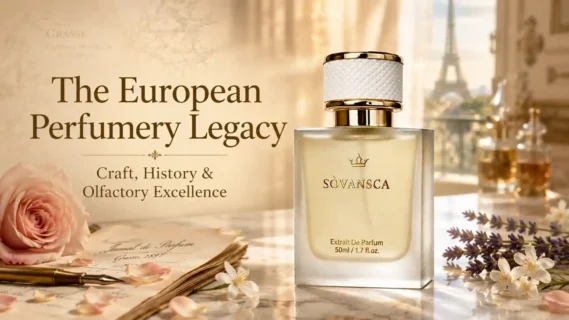
To understand fine fragrance, you must understand Europe — specifically the traditions of France and the broader continent that transformed perfumery from an ancient functional practice into an elevated art form with its own language, philosophy, and canon of excellence. The history of European perfumery is not merely a history of pleasant scents. It is a history of cultural ambition, of the pursuit of beauty as a serious discipline, and of the belief that the olfactory sense deserves the same respect and rigour as any other creative form. It is a tradition that shaped the standards by which all serious fragrance is still measured today.
Grasse: The Cradle of Fine Perfumery
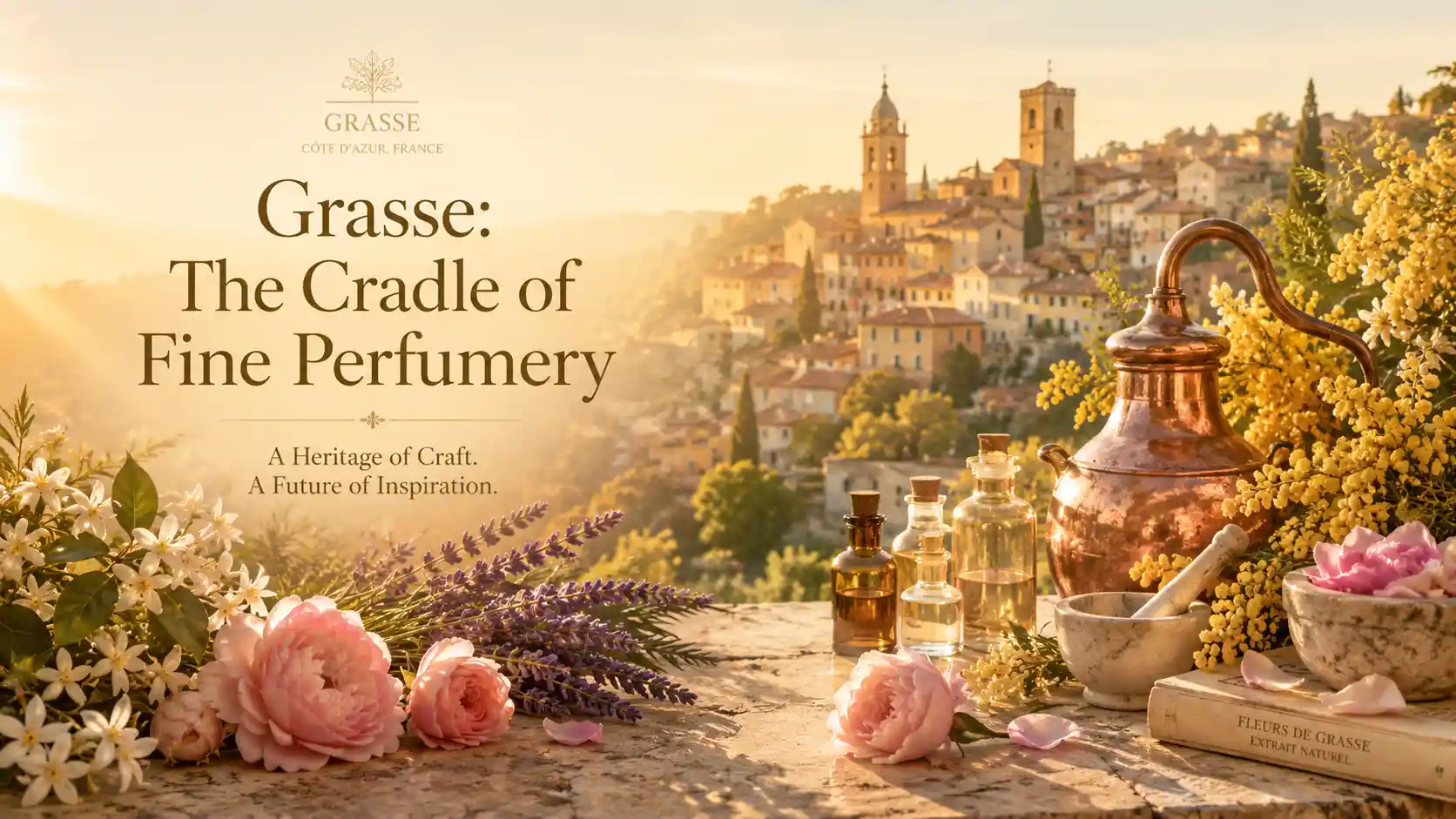
The story begins in Grasse, a small hilltop town in the South of France perched above the Côte d’Azur. In the seventeenth century, Grasse was already known for its leather-working industry — and it was the practice of perfuming gloves, worn by European nobility to disguise the smell of the tanning process, that first drew the attention of French perfumers to the region’s extraordinary aromatic resources.
The microclimate of the Grasse valley — warm, sheltered, and distinctly Mediterranean — proved ideal for growing aromatic plants of exceptional quality. Jasmine, rose de mai, lavender, violet, tuberose, and mimosa flourished there in an abundance and concentration of aromatic richness that is difficult to replicate anywhere else on earth. By the eighteenth century, Grasse had become the world’s premier source of high-quality natural aromatic materials, supplying the great luxury perfume houses of Paris and the courts of Europe. Today, Grasse remains the symbolic capital of world perfumery and is recognised by UNESCO as a site of Intangible Cultural Heritage. A single kilogram of Grasse jasmine absolute requires more than eight thousand hand-picked flowers — and commands a price that reflects its extraordinary rarity. The town’s legacy is not historical sentiment. It is an active, living standard.
Paris and the Rise of the Luxury Maison
If Grasse provided the raw materials, Paris provided the vision. The great Parisian perfume houses that emerged in the nineteenth century — armed with the finest available aromatic materials, the patronage of aristocracy and royalty, and the creative ambition to build something lasting — elevated perfumery to an art form that commanded serious cultural attention.
The concept of the luxury maison in perfumery — a house built around a singular aesthetic vision, committed to exclusivity, and identified with a standard of quality that justified its name — was born in Paris. It was here that the idea took hold that fragrance could be more than pleasant: it could be profound, narrative, architectural. It could carry the emotional weight of a great piece of music or a perfectly constructed sentence. The houses that emerged from this tradition did not merely sell perfume. They sold a point of view about beauty, elegance, and what it meant to inhabit the world with genuine refinement. This vision remains the definitive standard against which luxury fragrance is measured, and it is the standard that directly shapes every creative decision made at SOVANSCA.
Le Nez: Perfumery’s Greatest Artisan
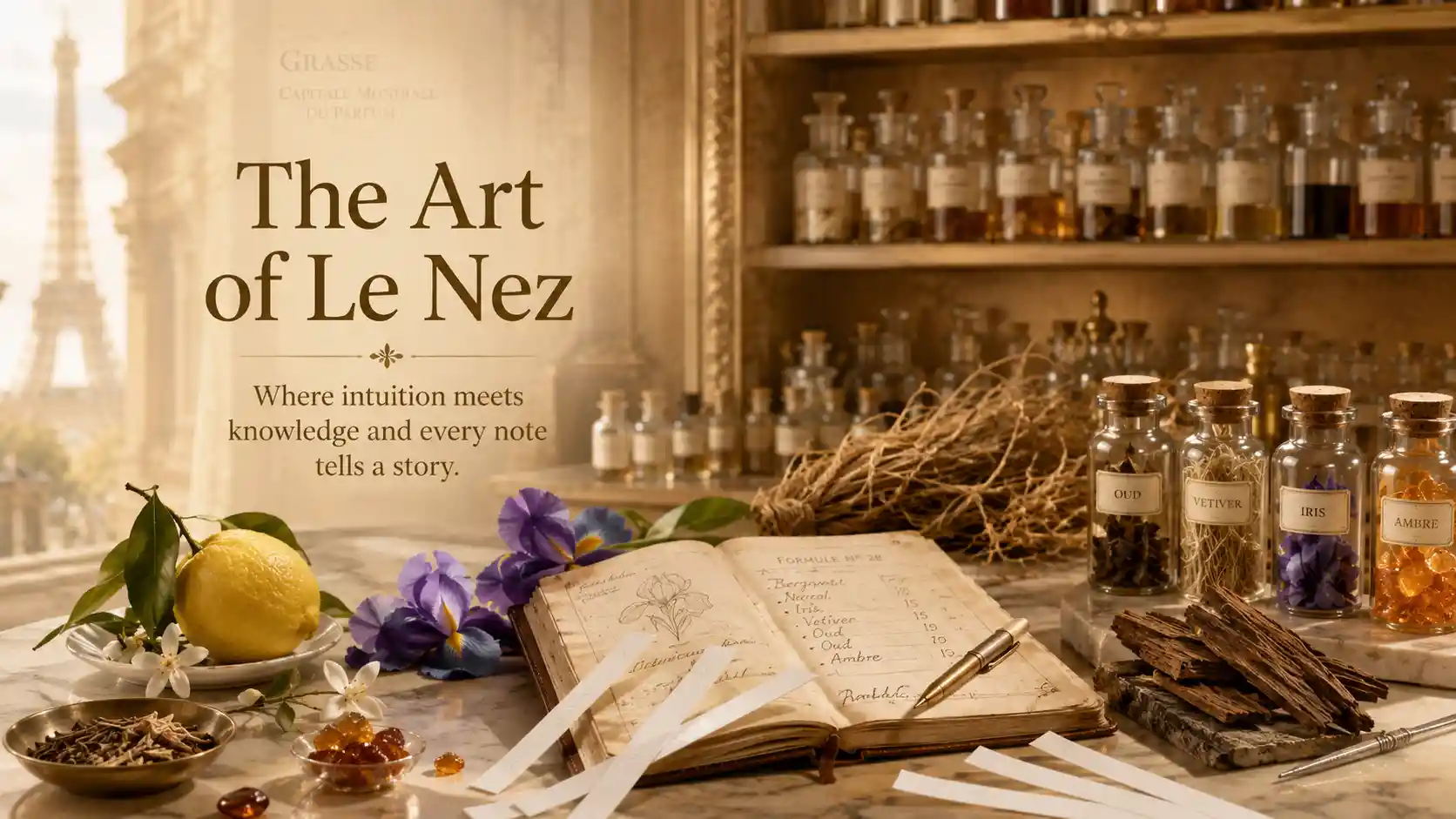
Central to the European perfumery tradition is the figure of the master perfumer — le nez, literally ‘the nose.’ In no other creative discipline is a single sensory faculty elevated to such a degree of importance and respect. A trained nose is a rare and extraordinary instrument: capable of distinguishing thousands of individual aromatic compounds, of holding entire olfactory compositions in memory, of predicting how individual ingredients will interact over time, and of assembling them with a precision that exists at the intersection of science and art.
The training of a fine perfumer in the European tradition is a multi-year, often multi-decade process. Students learn to identify hundreds of raw materials by name, to understand their origin, behaviour, and volatility, and to work with the accumulated vocabulary of historical compositions while developing a distinctly personal creative voice. They study not just the craft but the discipline: the patience to live with a composition over days and weeks, to test and refine, to question every element before declaring it finished. When you wear a fine fragrance composed with this level of care, you are wearing the result of an entire lifetime’s accumulated expertise. That is worth understanding, and worth appreciating.
The Philosophy of Quality Ingredients
European luxury perfumery insists, above all else, on quality at the source. The finest rose absolutes from Grasse. Oud from sustainably sourced forests. Vetiver from Haiti. Iris root from the fields of Florence. Bergamot from Calabria. These are not interchangeable ingredients, and they are not chosen arbitrarily. Their origin, the conditions under which they were cultivated and harvested, the season, the methods of extraction — all of these variables shape the quality and character of the final aromatic material in ways that are profound and irreplaceable.
This is why great fragrance cannot be rushed and cannot be cheapened without being fundamentally compromised. Substituting a synthetic approximation for a natural raw material does not produce the same result at a lower cost. It produces a different result — one that may satisfy at a superficial level but lacks the depth, complexity, and living beauty of the original. The finest European houses have always understood this, which is why their formulations are not merely compositions of notes but compositions of the finest possible expressions of those notes. To choose quality at the source is to guarantee quality in the final creation. There is no shortcut around this principle.
SOVANSCA and the European Tradition
At SOVANSCA, we are directly and consciously inspired by these refined European traditions. We believe that fragrance is not a commodity to be manufactured at volume, but an experience to be crafted with the same rigour, intelligence, and aesthetic commitment that defines the finest moments in European perfumery history. Our relationship to this tradition is not nostalgia. It is active allegiance.
Our fragrances Moonlight Privé are composed using carefully selected, high-quality ingredients. They are developed with uncompromising attention to the full arc of their evolution on skin. They are released in limited quantities — never mass-produced, never diluted for wider distribution — because we believe that genuine luxury requires genuine scarcity, and that the integrity of a composition is inseparable from the care with which it reaches the wearer. In this way, SOVANSCA takes its place in a tradition that stretches from the jasmine fields of Grasse to the great houses of Paris: a tradition built on the conviction that fragrance, crafted with total commitment, is one of the most powerful and beautiful forms of human expression.
The European perfumery legacy is not a museum piece. It is a living standard — a set of principles about quality, craft, and the transformative power of scent that continues to define the very best of what fragrance can be. When you choose a fragrance rooted in these traditions, you choose more than a product. You choose a philosophy. You choose excellence.