



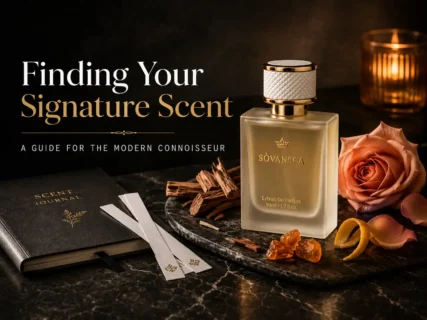
In a world saturated with fragrance — celebrity scents, department store counters, and algorithmically curated bestsellers — finding a scent that is truly yours is an act of genuine self-knowledge. It requires patience, an educated nose, and the willingness to move beyond what is popular in order to discover what is personal. A signature scent is not simply a pleasant fragrance. It is a consistent element of your identity, as recognisable to those who know you as the sound of your voice or the way you enter a room. The process of finding it is worth taking seriously.
Understand the Fragrance Pyramid
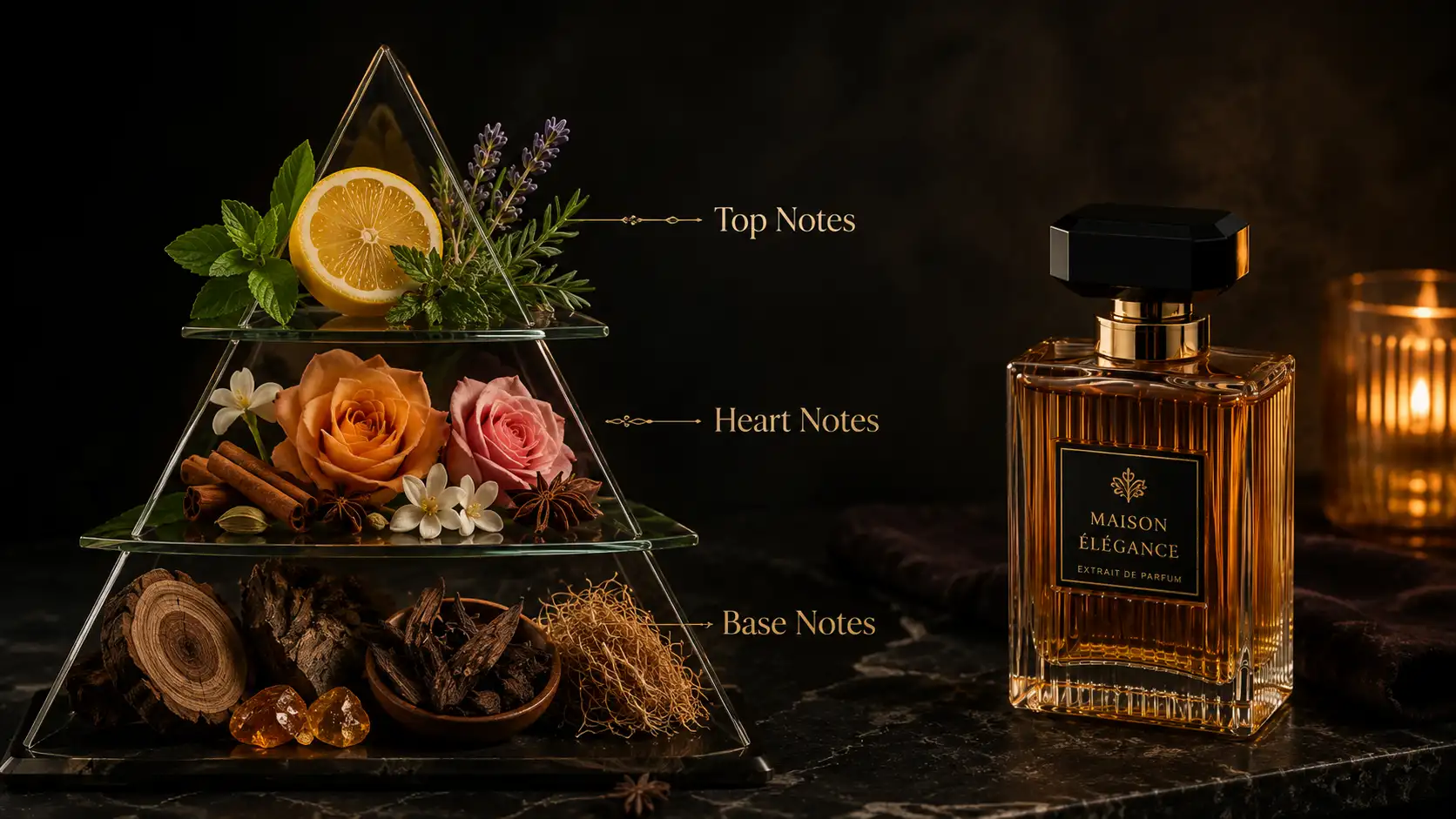
Every fine fragrance is built on three tiers, known collectively as the fragrance pyramid: top notes, heart notes, and base notes. Each tier plays a distinct role in the composition, and understanding them is essential to making an informed choice rather than an impulsive one.
Top notes are what you smell immediately upon application — bright, light, often citrus-forward or herbaceous. They are designed to make a strong first impression, but they are also the most fleeting, typically lasting no more than 15 to 30 minutes before dissipating. Many people make the critical mistake of deciding on a fragrance at this stage, drawn in by an appealing opening awithout experiencing what lies beneath. Heart notes emerge after the top notes have faded, representing the true character of the fragrance: floral, spicy, woody, or complex combinations thereof. Base notes arrive last and stay longest — musk, amber, sandalwood, oud, vetiver — sometimes persisting for an entire day or more. When choosing a signature scent, the base notes are what you will live with the most. Allow the fragrance to fully reach them before committing to a decision.
Learn Your Fragrance Families
Luxury fragrances are grouped into families based on their dominant character: Oriental, Woody, Floral, Fresh, and Chypre, among others. Developing an understanding of which families consistently speak to you is one of the most effective ways to focus an otherwise overwhelming search.
The Oriental family — warm, spiced, resinous, often featuring oud, amber, incense, and dark florals — speaks to those drawn to depth, mystery, and a certain compelling gravity. It is the fragrance equivalent of a quiet, low voice in a crowded room: immediately distinctive. The Woody family, built on cedarwood, vetiver, sandalwood, and patchouli, tends to appeal to those with a preference for restraint and understated sophistication. Floral families offer enormous variation, ranging from the powdery and romantic to the green and sharp. Fresh families, built on citrus or aquatic accords, feel immediate and energetic, though their longevity is typically lower than warmer compositions. There are no rules about which family suits which person. The vocabulary of fragrance families is a map, not a prescription — use it to navigate, not to limit.
Test with Intention
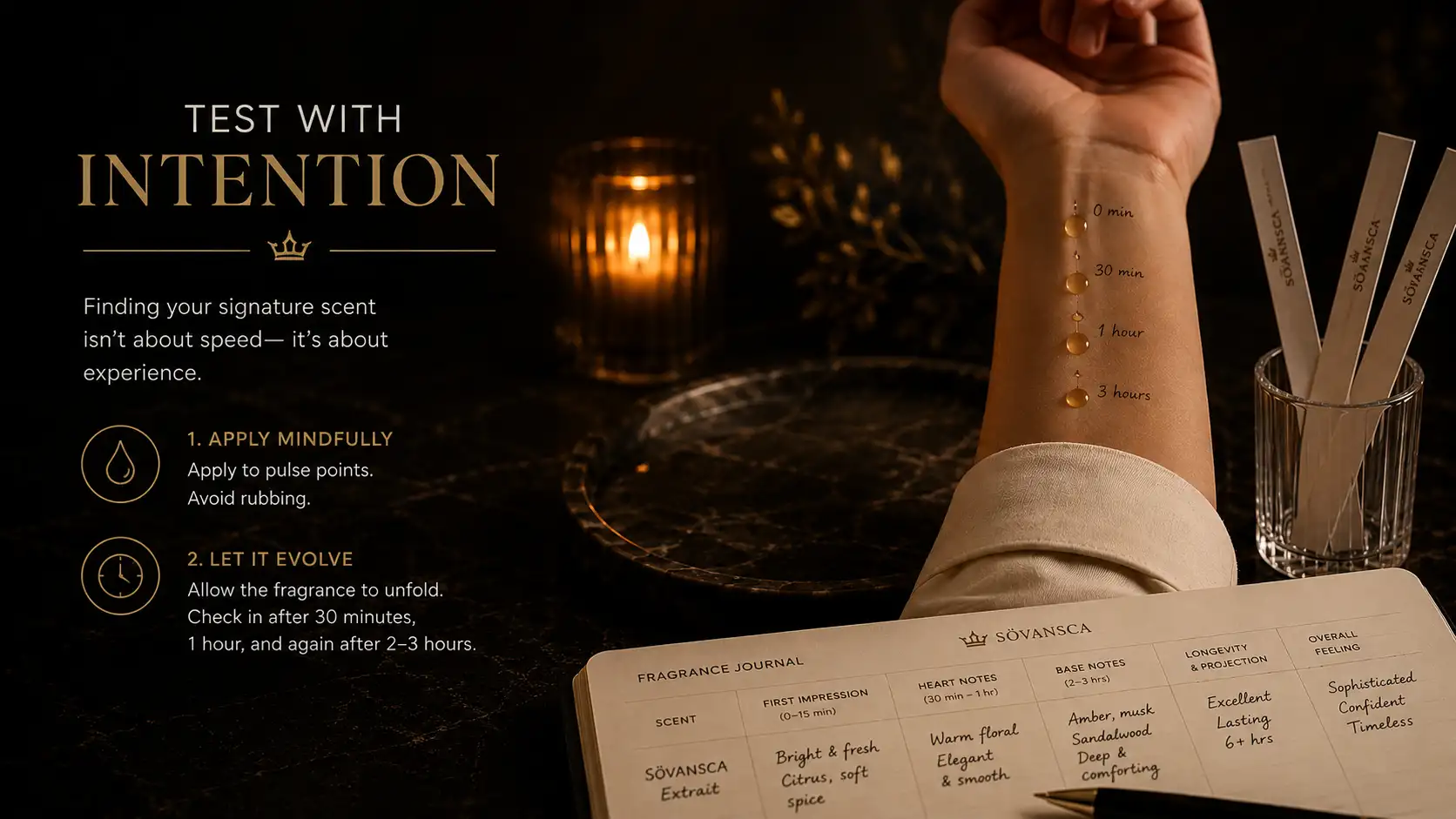
Testing fragrance with intention means slowing down. Apply fragrance to your wrist or inner elbow — warm areas where blood flows close to the surface of the skin, creating ideal conditions for the fragrance to evolve naturally. Avoid rubbing the applied area, which breaks down molecular bonds and distorts the scent in ways that do not accurately represent the original composition.
Apply no more than two or three fragrances in a single session. The nose fatigues quickly, and an overwhelmed nose is an unreliable judge. Use fragrance strips for an initial elimination round, but do not make your final decision based on paper alone. Then, critically, wait. Come back after 30 minutes. Come back after an hour. Come back after two or three hours, when the base notes have fully developed and the fragrance has had time to become genuinely part of you. The version you encounter at the third hour is far closer to the one that will define you as its wearer. A hasty decision made at the counter in the first minutes is almost always a decision made in error.
Skin Chemistry and the Personal Factor
No two people smell a fragrance in exactly the same way — and no two people wear a fragrance in exactly the same way. Skin chemistry is a deeply personal variable that interacts with every element of a composition, from the way individual notes develop to the longevity and projection of the overall scent. Factors including skin pH, hydration, diet, and even stress hormones can alter how a fragrance performs on your skin.
This is why a fragrance that is extraordinary on someone else may smell entirely different — or only subtly different, but crucially so — on you. It is also why reading reviews and following recommendations, while useful for narrowing options, can never substitute for the direct experience of testing on your own skin. Hydrated skin holds fragrance better and longer; applying a light, unscented moisturiser before your fragrance can significantly improve longevity. Understanding how your skin interacts with fragrance, and working with it rather than against it, is part of developing a genuine, lasting relationship with a scent.
Choose Exclusivity Over Ubiquity
A signature scent is, by definition, not widely shared. When a fragrance becomes ubiquitous — found in every department store, worn by people in every context, so familiar that it has become a cultural reference rather than a personal one — it ceases to function as a signature. The modern connoisseur understands that true signature requires rarity: the fragrance cannot be easily placed or commonly recognised, because it is not something most people have ever encountered.
This is why small-batch, limited-edition fragrances represent the highest form of olfactory self-expression. They ensure that what you wear speaks only of you. At SOVANSCA, exclusivity is not a marketing strategy. It is a creative principle. Our fragrances are crafted in private batches and never mass-produced — precisely so that those who wear them remain singular. The 200 bottles of Moonlight Privé Extrait de Parfum that exist in the world will never become a cultural commonplace. They will always be extraordinary, because they are, and always will be, rare.
Fragrance trends shift with every season. Signature scents do not. The right fragrance will feel less like a discovery and more like a remembering — the unmistakable sensation of encountering something that was somehow already yours before you found it. Trust that instinct. It is, in the end, the most reliable guide you have.